
The first job usually arrives before the money does. A producer sends a script and asks what it costs, and the answer has to be good enough that a financier can hold the line producer to it six months later. That's a week of work: read the script twice, break it down, board a realistic schedule, and build the budget off the day count. The piece that gets skipped under deadline is the assumptions page, and it's the page that saves the line producer later.
Write the assumptions before the numbers
Every budget rests on decisions that aren't visible on the top sheet. Write them on the first page, in plain sentences, so a financier or completion guarantor can see what they're buying:
- Script version and date (for example, "blue revision, 8/28, 101 pages").
- Shoot days, days per week, and the average pages per day that implies.
- Union status and agreement tier for cast and crew.
- Prep and wrap weeks for each department head.
- Where the show shoots and whether an incentive is in the finance plan.
- Contingency percentage and whether a completion bond is included.
The day count line does the most work. A 101-page script boarded at 25 days is 4.04 pages a day (101 / 25). If the director's cut of the board comes back at 23 days, the pace rises to 4.39 pages a day, and the line producer has to ask the 1st AD whether that's achievable with the stunt day and the two night exteriors, before anyone celebrates the savings. The critical assumptions guide covers what else belongs on that page.
Where the schedule and the budget drift apart
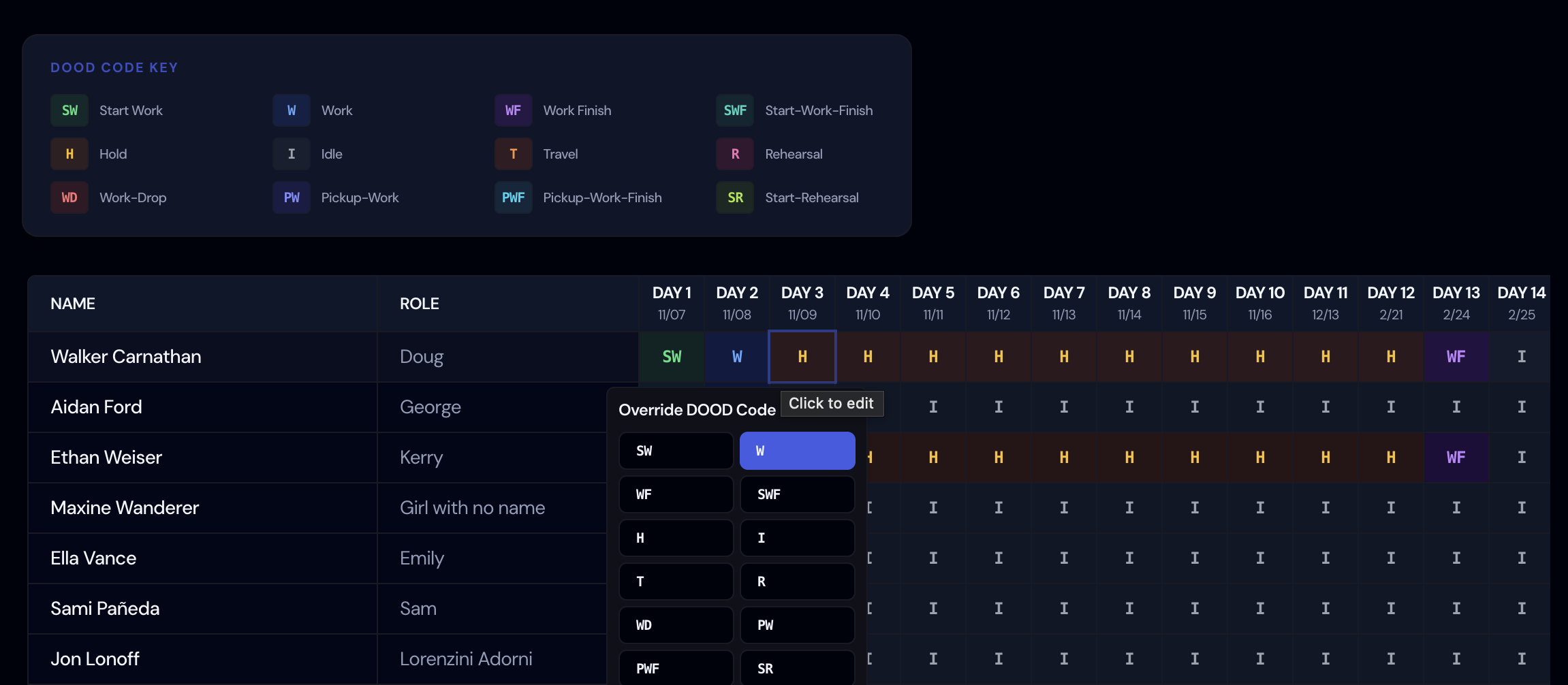
Cast is the line that drifts first, because it depends on the order of scenes as much as the number of days. Take an actor on a $1,200 day rate who works days 3, 4, and 9 of a feature.
| Day | 3 | 4 | 5 | 6 | 7 | 8 | 9 |
|---|---|---|---|---|---|---|---|
| Code | SW | W | H | H | H | H | WF |
Carried straight through, that's 7 paid days: $8,400 before fringes. If the agreement allows a drop and pickup and the gap qualifies, the actor might be paid for 3 work days instead, $3,600, saving $4,800. If it doesn't qualify, the cheaper fix is moving the day 9 scene to day 5 so the actor finishes in three consecutive days. Either way, the line producer only sees the problem if the day out of days is current. The fringes guide covers the payroll percentages added on top of those figures.
Locations drift next. A location fee negotiated for two days becomes three when the AD splits a heavy scene across a day break, and nobody tells the accountant until the invoice arrives. Equipment follows the same pattern: a crane priced for one day on the budget sits on a truck for three because the scenes that need it moved apart on the board.
The habit that catches all of this is a weekly reconciliation during prep. Put the current one-line next to the budget and walk the cast, location, and special equipment lines day by day. It takes an hour and a half on a 25-day show.
Incentives belong in the budget, with the math shown
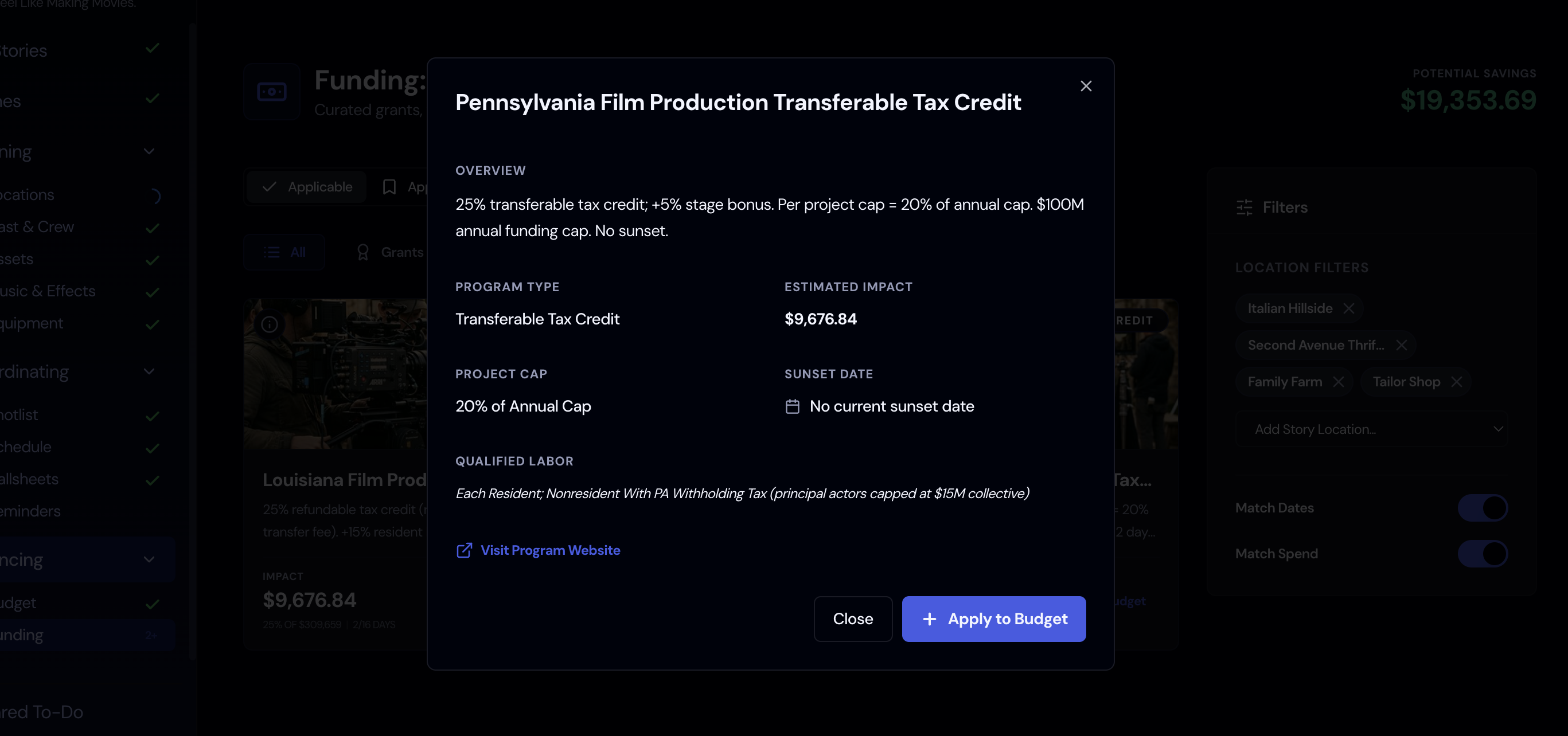
Producers often arrive with an incentive percentage and no calculation. The line producer's version starts from qualified spend. On a $2,000,000 budget where $1,300,000 is spent in state on qualifying costs, a 25% credit is worth $325,000 ($1,300,000 x 0.25), not $500,000. Transferable credits are often sold at a discount, and there are caps, resident labor rules, audit costs, and minimum spend thresholds. The incentive calculator and how film tax credits work walk through the variables, and the film office's own program page is the source to cite.
Handing it off
When the show is financed, the budget stops being an estimate and becomes the plan the UPM spends against. Hand the UPM and accountant a film budget with the assumptions page attached, the one-line it was built on, and a note on every line that's a placeholder. The hot cost report takes over from there.
Where Storiara fits
Storiara builds the scene list, page counts, and breakdown from an uploaded PDF, Word, or Final Draft script, and the stripboard is a manual drag-and-drop board. The day out of days fills in for cast from that board, and the budget reads cast paid days from it, so moving a scene changes the cast line after a sync. The budget is calculated from rate tables and the rates you enter, organized as above-the-line, below-the-line, post, and other, with a top sheet, contingency, and optional completion bond. It doesn't track actuals, purchase orders, or cost reports, so those stay with the accountant's software. For a longer walkthrough, read Storiara for line producers.