
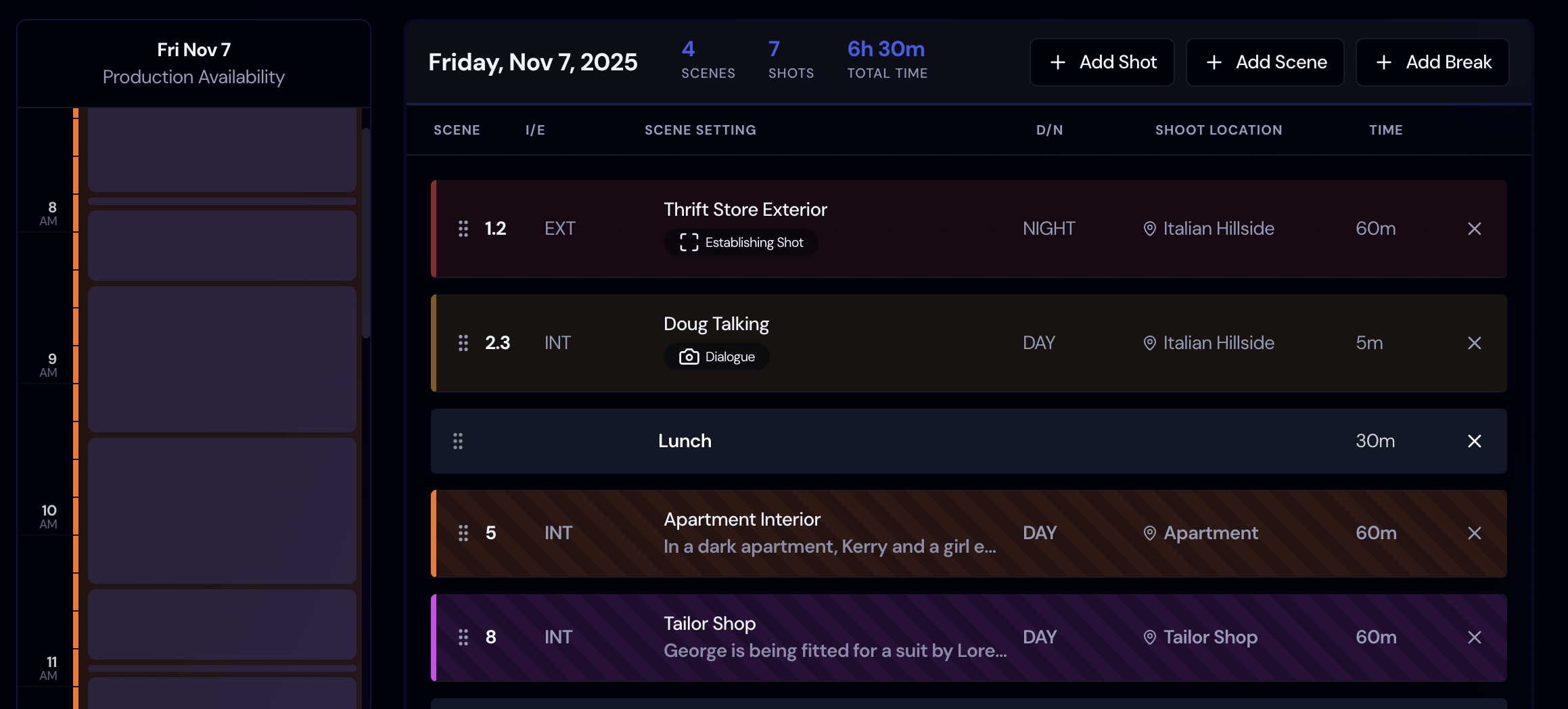
A production course works best when each assignment is a document a real production office would recognize, handed in on the same schedule an office would produce it. Students learn eighths by counting them, and they learn why a stripboard exists the first time they try to shoot a 12-page thesis in script order.
Prep as a five-week sequence
Many programs compress prep for a short or thesis film into five or six weeks of assignments. A sequence that mirrors a real prep calendar:
| Week | Deliverable | What you're checking |
|---|---|---|
| 1 | Script with scene numbers and page counts in eighths | Consistent scene headings, eighths that add up to the script length |
| 2 | Breakdown sheets for every scene | Speaking roles, background, props, wardrobe changes, vehicles, stunts |
| 3 | Stripboard and one-line schedule | Scenes grouped by location, a sane number of pages per day |
| 4 | Day out of days and budget | Cast work days match the board, the top sheet adds up |
| 5 | Call sheet for day one | Call times that work backward from the first shot, hospital, parking |
The week one check is pure arithmetic and catches more than you'd expect. An 11-page script is 88 eighths. If a student's scene list adds up to 10 5/8 pages (85 eighths), three eighths are missing somewhere, usually a short insert scene that never got its own number or a scene heading the student skipped. The page count calculator and how to calculate script page counts make good pre-reading.
What to look for when grading a schedule
Student schedules tend to fail in the same few ways, and pointing at the specific strip teaches more than a general note.
Script order is the most common. A student shoots scene 1 at the apartment, scene 2 at the diner, and scene 3 back at the apartment, which is two company moves in a day that needed none. Ask them to regroup by location and count the moves before and after.
The second is page load. Four pages a day is a comfortable pace on many student shoots with a small crew, and a day with 8 pages, a night exterior, and a child actor is a fantasy. Have students write the pages per day at the bottom of each day strip so they see the imbalance themselves.
The third is rest. A student who wraps a night exterior at 2:00 a.m. and calls the same actors at 7:00 a.m. has given them five hours. Whatever rule your program sets for student crews, the turnaround calculator makes the problem obvious. Sunset matters for the same reason: an exterior day scene scheduled for 5:30 p.m. in November in the northern states is a night scene, and the sunrise and sunset planner settles it.
The last one is cast days. If an actor works on day 1 and day 4, a student should know whether they're paying (or asking a volunteer to hold) days 2 and 3. That's what the day out of days is for, and it's a good place to introduce the SW, W, H, and WF codes.
Thesis films and shared resources
Thesis projects add a layer the classroom exercises don't have: the school's equipment room, stage calendar, insurance, and whatever permit process runs through the program office. Those offices usually need dates earlier than students think. A greenlight review that asks for a locked one-line, a budget, and a location list two or three weeks before the first shoot day gives the equipment room time to catch two crews asking for the same camera package on the same weekend.
Rotating crew positions also means students inherit each other's paperwork. The student who was 1st AD on one project becomes the producer on the next, and the handoff goes much better when the schedule, cast list, and locations live in one shared project instead of a group chat. The thesis film pre-production checklist and how to plan a student film in 30 days are both written for students running that process.
Using Storiara in a course
Instructors create classes in My Classes, and each class has a six-character join code, a roster, and assignments with a title, description, due date, and submission type (story, file, or both). Students join from Account Settings and get Pro-level access as class members, then submit from My Assignments. A submitted story carries the student's scenes, breakdown, schedule, and budget, so you can open the stripboard and check the strips directly. Grading stays in your own gradebook; Storiara has no grading tools. Program details are on the education page, and the student films solution covers the student side.