
A spec script is written for a reader. A shooting script is also read by a 1st AD, a location manager, a prop master, and an accountant, and each of them turns specific parts of the page into work. Writers who produce their own shorts learn this fast. Writers on a feature learn it from notes, usually phrased as "can we make this cheaper," and the note lands better when the writer already knows which lines are expensive.
Scene headings are the schedule's raw data
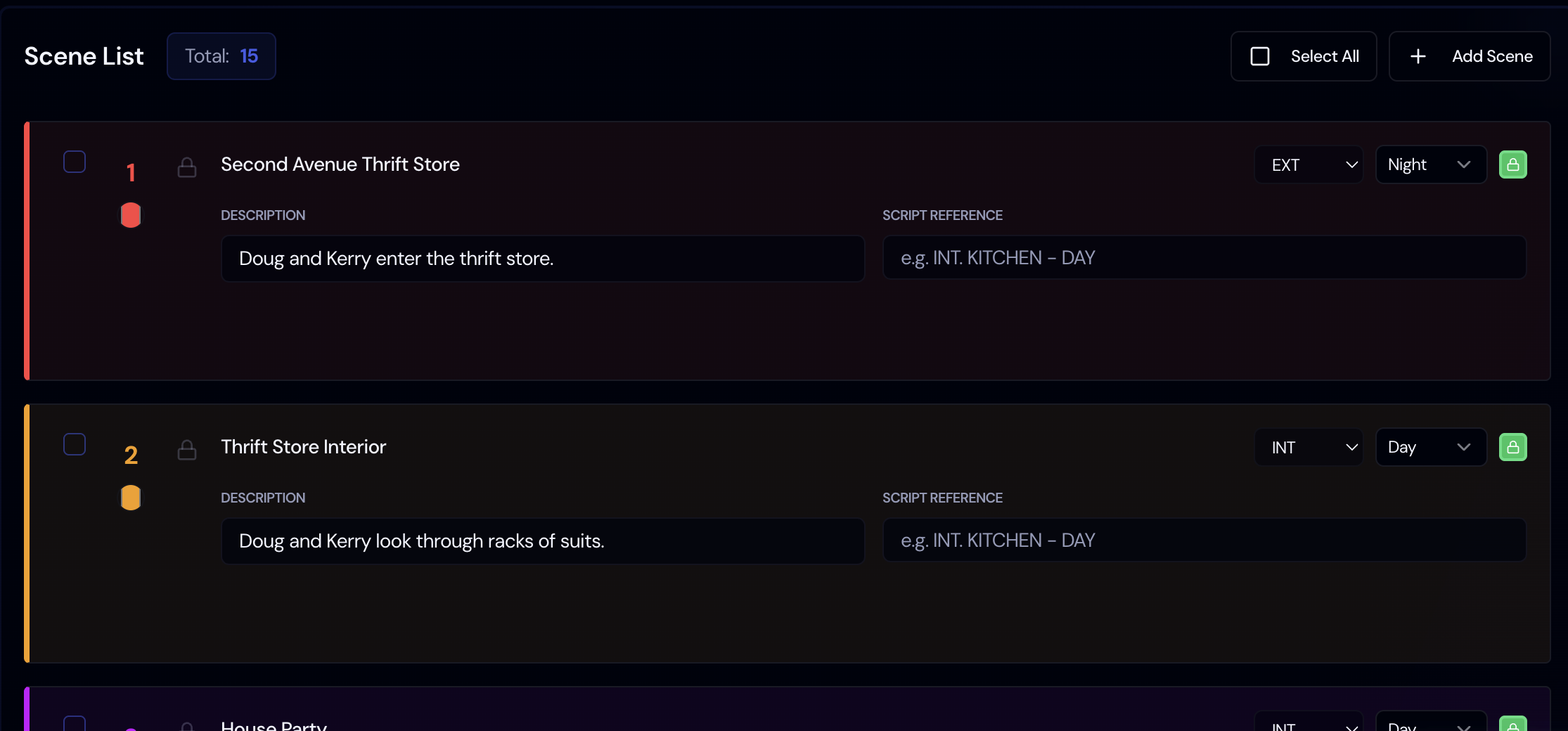
The AD's breakdown reads three things from every scene heading: interior or exterior, the location, and day or night. Every scene with the same location name becomes a candidate to shoot together, and every change in day or night is a lighting and turnaround question.
That makes consistency matter more than style. Here's a draft where the same apartment appears under four names:
| As written | What the breakdown sees | Cleaned up |
|---|---|---|
| INT. MAYA'S APARTMENT - KITCHEN - NIGHT | Location 1 | INT. MAYA'S APARTMENT - KITCHEN - NIGHT |
| INT. MAYA'S KITCHEN - LATER | Location 2, time unclear | INT. MAYA'S APARTMENT - KITCHEN - NIGHT |
| INT. MAYA'S PLACE - BEDROOM - DAY | Location 3 | INT. MAYA'S APARTMENT - BEDROOM - DAY |
| INT. APARTMENT - CONTINUOUS | Location 4, whose apartment? | INT. MAYA'S APARTMENT - HALLWAY - DAY |
Headings with LATER or CONTINUOUS are fine in a spec, but the AD still has to work out whether that scene is day or night, and a guess on a 90-page script is how a night scene lands on a day schedule. The cleaned version keeps one location name, sets the area after the first dash, and states the time. The slugline glossary entry and how to number a film script for production cover the rest of the conventions.
Which lines cost money
Most expensive lines are short. A producer asking for a cheaper draft is usually asking about some of these:
| On the page | What production has to do |
|---|---|
| EXT. ... - NIGHT | Night lighting, a late crew call, turnaround into the next day |
| "Rain lashes the windshield" | Rain towers or a water truck, wet-down, a second take means drying everyone |
| "The crowd roars" | Paid background actors, holding area, wardrobe, meals |
| A child character with several scenes | Limited working hours, a studio teacher on many shows, a guardian on set |
| "She speeds down the highway" | Picture car, a process trailer or tow rig, road permits, police |
| A dog that does a specific action | A trained animal, a handler, often a backup animal |
| A gun, a fight, a fall | Armorer or stunt coordinator, rehearsal time, safety meeting |
Writing around them rarely means losing the scene. The highway argument can happen in a parked car. The crowd can be heard from a corridor under the stands. The rainstorm can be established in one exterior shot and played inside. A writer who answers the note with one of those alternatives keeps more control of the draft than one who waits for the producer's version. Breaking down stunts, SFX, and VFX shows how the crew itemizes these.
Reading your own page count
Production measures scenes in eighths of a page: each page is divided into eight bands, and a scene that runs from the top of page 12 to three bands down page 13 is 1 3/8 pages. Eighths are good at measuring how much text there is and poor at measuring shoot time.
Compare two scenes. A 4-page dialogue scene between two people in one kitchen might take half a day. A 1-page montage ("Maya at the bus stop. Maya at the bank. Maya on the bridge at dusk.") covers three locations, three wardrobe looks, and a dusk shot with a narrow window, and could take a full day with two company moves. When a producer asks why a 94-page script needs 26 days, the montages and short exteriors are often the answer. The page count calculator helps you check eighths, and what is a script breakdown explains how they're used.
When the script becomes a shooting script
At some point the draft is locked for production and scene numbers are added. After that, a new scene between 23 and 24 becomes 23A, and changes go out as colored revision pages. That discipline exists because the crew has already built schedules and budgets on the numbers. The writers' assistant page walks through how revision pages are issued on a series.
What Storiara shows a writer
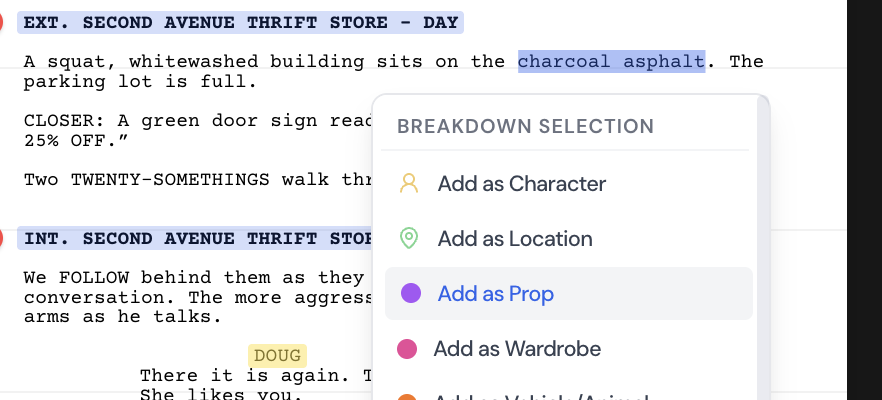
Storiara imports Final Draft, Word, and PDF scripts and splits scenes from the headings, so an inconsistent heading shows up as an extra location in the list. It pulls characters, extras, props, wardrobe, and music and effects from the pages, checks each item against a quote from the script, and calculates page counts in eighths from the layout. Smart Review returns a checklist grouped under Prep, Scheduling, and Budget. Storiara doesn't export back to Final Draft, so edits to the script itself happen in your writing program.